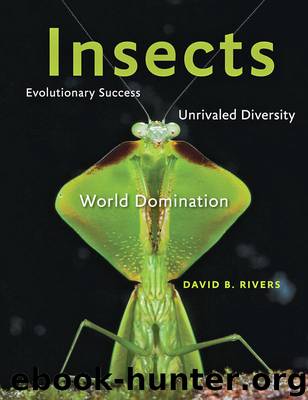
Insects: Evolutionary Success, Unrivaled Diversity, and World Domination by David B. Rivers
Author:David B. Rivers [Rivers, David B.]
Language: eng
Format: azw3
Publisher: Johns Hopkins University Press
Published: 2017-04-30T04:00:00+00:00
CCC: Calling, courting, and copulation ■ Sex cannot occur until the mates find each other and then unite. Since a male and female often do not develop in the same location, and are sometimes separated by more than a mile, there is an absolute need for the potential lovers to find each other. Insects rely on smell, visual cues, sound, and even taste to locate mates. Some species depend on multiple senses for mate-finding, others depend almost exclusively on chemical cues or auditory signaling. Several species display courting behaviors remarkably similar to humans, as in a male who cannot resist the harmonic singing of a beautiful young female desiring to bring children into the world, or male suitors trying to win the love of a female by bringing her gifts, or a couple that engages in dancing as sultry as a Latin salsa to check each other out before making a commitment.
■ Calling is a process in which one individual signals to another an eagerness to mate, as well as advertising a location to meet. Calling is really a means for soliciting sex. Bringing the sexes together when they are in close proximity to one another depends on visual cues more often than not. By contrast, when the male and female are separated by a substantial distance, chemical signals that can permeate through the air or water are necessary, or making noise (auditory signaling) is needed to get the attention of a potential suitor. Visual cues can range from individual displays to a mass effect; for the latter, swarming or aggregation of males are the two most common approaches.
■ Color patterns or markings on the body and/or wings are how a male catches the eye of a female. The patterns that the insects see may be quite different from our color vision, as patterns visualized in infrared are important for species recognition and mate identification for many species. Visual calling can also be associated with movements, as in the way the male or female slowly and seductively flaps its wings, or in crazed dancing, usually performed by the male, and also through the use of bioluminescence.
■ For some insects, the way to true love is through song. Well, maybe not always singing per se, but at least by making noise that the courted simply cannot resist. Noise-making is almost always the job of the male. Members of the order Orthoptera “sing” using their wings. Each forewing has a hard edge called a file that is rubbed over a comb-like scraper on the other wing, a technique called stridulation. Male cicadas (Hemiptera) also sing to court females, using vibration of abdominal membranes to produce the characteristic shrill-pitched sound that girls cannot resist.
■ Undoubtedly the most powerful tools insects use to convey a desire to have sex are chemical signals. The cues are sex pheromones. Both sexes can produce them, but more often than not, a female, through the release of her chemical signature, calls a male. The receiver in the relationship can readily be determined in
Download
This site does not store any files on its server. We only index and link to content provided by other sites. Please contact the content providers to delete copyright contents if any and email us, we'll remove relevant links or contents immediately.
Sapiens: A Brief History of Humankind by Yuval Noah Harari(14389)
The Tidewater Tales by John Barth(12659)
Mastermind: How to Think Like Sherlock Holmes by Maria Konnikova(7347)
The Thirst by Nesbo Jo(6944)
Do No Harm Stories of Life, Death and Brain Surgery by Henry Marsh(6941)
Why We Sleep: Unlocking the Power of Sleep and Dreams by Matthew Walker(6726)
Life 3.0: Being Human in the Age of Artificial Intelligence by Tegmark Max(5558)
Sapiens by Yuval Noah Harari(5372)
The Body: A Guide for Occupants by Bill Bryson(5097)
The Longevity Diet by Valter Longo(5065)
The Rules Do Not Apply by Ariel Levy(4969)
The Immortal Life of Henrietta Lacks by Rebecca Skloot(4588)
Animal Frequency by Melissa Alvarez(4474)
Why We Sleep by Matthew Walker(4447)
The Hacking of the American Mind by Robert H. Lustig(4383)
Yoga Anatomy by Kaminoff Leslie(4363)
All Creatures Great and Small by James Herriot(4322)
Double Down (Diary of a Wimpy Kid Book 11) by Jeff Kinney(4272)
Embedded Programming with Modern C++ Cookbook by Igor Viarheichyk(4182)
